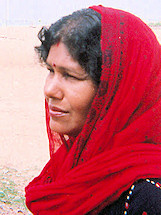
Interview
-
IR
: Sarojini Sahoo, you are well-known in India, especially in
Orissa. But people in France hardly know about you, so could you please
introduce yourself ?
SS : None
of my writings have been translated in French. You can know more about
me from the following links :
http://www.sarojinisahoo.com/index.html
http://sarojinisahoo.blogspot.com/
http://en.wikipedia.org/wiki/Dr.Sarojini_Sahoo
http://pt.wikipedia.org/wiki/Sarojini_Sahoo
http://www.oriyanari.com/id38.html
SS :
Orissa is a provincial state of India, having an ancient language and
rich literature with its ancient historical base. You can know more
about Orissa, Oriya Language and Oriya Literature from wikipedia by
clicking the links...
http://en.wikipedia.org/wiki/Orissa
http://en.wikipedia.org/wiki/Oriya_language
http://en.wikipedia.org/wiki/Oriya_literature
http://en.wikipedia.org/wiki/Oriya_script
SS : I
can’t say which of my novel is the best of mine. I think my masterpiece
is yet to be written.
In my novel Upanibesh, which is considered as the first
attempt in the Indian novel to discuss about female sexual desire, I
have taken the “Shiva Linga” as the symbol for sexual desire of women.
Medha, the protagonist of Upanibesh ("The Colony"), was a
bohemian. In her pre-marital stage, she would think that it was boring
to live with a man all life long. Perhaps she wanted a chain free life,
where there would be only love, only sex, and no monotony. In my novel
Pratibandi, the thematic development of sexuality in a woman has
been discussed. Priyanka, the novel’s protagonist has to face the
loneliness of exile in a remote village, Saragpali. This loneliness
develops into a sexual urge and soon Priyanka finds herself having a
sexual liaison with a former Member of Parliament. Though there is an
age gap between them, his intelligence impresses her and she discovers a
hidden archaeologist in him.
In my novel Gambhiri Ghara ("The dark Abode"), I want to
glorify the power of sexuality, where Kuki, the protagonist, a Hindu
married woman of India, tries to rectify Safique, a Muslim Pakistani
artist and keep him away from perversion and being a sex maniac. She has
convinced Safique that without love lust is like the hunger of a
caterpillar. Gradually they become involved in love, lust and
spiritually. Though this is not the central theme of the novel, its
broad acceptance of sexuality has made the fundamentalists react. This
novel has been translated into Bangla and was published in Bangladesh in
2007, under the title Mithya Gerosthali.
In my various stories I have painted lesbian sex, rape, abortion,
infertility, failed marriage and menopause... I was also very much
criticized for using the word ‘fuck’ in my story "Rape".
But sexuality or feminism is not just the radical base of my novels and
short stories. In three of my novels (Mahayatra : "The Great
Travel" ; Swapna Khojali Mane : "The Dream Searcher ";
Pakshibasa : "The nest") the protagonists are not females, and the
novels deal with different subject. “The Dream Searcher” and “The Nest”
are about poverty, exploitation, whereas “The Great Travel” is about
the search for the Eternal Truth of life. In my different stories I have
used used my own nostalgia to explore the theme.
SS : In
writing, I have been influenced by many Western writers like Dostoevsky,
Kafka, Joyce, Garcia Marquez, J.M. Coetzee. But I don’t think of any of
them as my idol. If I were to consider anyone as an idol, that would be
Jagadish Mohanty, my husband, a veteran Indian writer of Oriya
Literature whom I consider my teacher, friend and philosopher.
SS : Our
society has grown into a polar male-female dichotomy system, where the
former is oppressing the latter and treating them as ‘other’ or similar
to lower caste.
Patriarchy is just one of the hierarchies in the traditional system,
where females are most oppressed. The feminist argument for sexual
equality works in two directions. First, it exposes the ways in which
patriarchy exploits the sexual difference to create systems of
inequality and exposes the facts of sexual politics, which later lead to
Feminism, to the fight against male hegemony. It also claimed that as
long as the standard of equality is the male body, the discriminatory
sexual difference will remain in play. Secondly, it acts as a prime
source for the gender theories : the ‘others’ theory developed by Simone
de Beauvoir in the later period.
Plato once said in his
Republic
that “... the only difference between men and women is one of physical
function - one begets, the other bears children. Apart from that, both
can and should perform the same functions (though men on a whole,
perform better) and should receive the same education to enable them to
do so ; for in this way society will get the best value from both.”
I admit that the male can perform some functions more skilfully than
women, but similarly there are some functions where women usually show
their proficiency over men... The gender role and sexuality have a major
role in the understanding feminism In India. Arranged marriages are
still preferred, and love marriages are considered a matter of social
sin and shame. Many Indians contend that arranged marriages are more
successful than marriages in the West, particularly given the latter's
staggering divorce rates.
Romantic love does not necessarily lead to a good marriage, and it
often fails once the passion dissipates and real love flows from a
properly arranged union between two individuals, they argue. An
unmarried daughter -- pronounced a spinster even in her late twenties –
will bring shame upon her parents, and is a burden. But once married,
she is considered the property of her in-laws.
In this context un-wed mothers, separated, single or unfaithful women
are considered outcasts. Living out of wedlock with a partner is still
virtually unheard of. During their marriage, the bride’s father has to
pay dowries in the form of lots of money, furniture, jewelry, and
expensive household items and even homes and expensive foreign holidays
to the bridegroom and still the phrase "bride burning" was coined in
India after several young brides had their saris lit on fire in front of
a gas stove either by their husbands or in-laws because of their
father's failure to meet the demands for a bigger dowry.
As it is a custom and tradition in the joint family, a bride has to
face her tyrannical in-laws, and the traditional Hindu society still
rejects divorcees. In the case of sexuality, the active role of women
has been always denied and it is considered that women should not be
open to their sexual desires. For this reason you will find many women
have been through their menopausal stage without having had a single
orgasm on any day. In religious rituals and customs also the females are
barred from taking part in all worship.
In Kerala, the females are not allowed to enter in the Ayappa
temples. They are also barred to worship the God Hanuman and in some
regions they are barred to even touch the linga idol of Lord Shiva. In
recent politics also though all political parties have assured in their
manifesto they would reserve 33% of seats in legislation, still it has
not been transformed into law, as the male dominant political parties
are opposing the bill.
In financial matter, though women are allowed to work outside, their
rights on any house holdmatters have always been denied. A woman has to
take charge of the kitchen, even if she is an earning member and she has
to leave her house to work. The husband will not take charge of the
kitchen, though he remains unemployed, as it is supposed for a man to
cook for his family is against his manhood. Legally, though according to
Court, sons and daughters have equal rights on patriarchal property,
still now as per practice, ownership changes hands from father to
husband to son and the role of a daughter or a daughter in law is
denied.
And about Feminism, I think my life is my source of inspiration. Have
you gone through the article “The Bicycle and me” on my blog “Sense and
Sensuality” ? I have described how I became a feminist. I am my parents’
second daughter. Before my birth, my father was expecting a son and when
I was born, he was not present besides my mom. Finding myself a female
baby, my mother had a shock, because my birth could be the reason for
her future humiliation.
My mom told me later she could not sleep during the night due to her
fear of facing my father with a girl child. She had been praying all
night to God to change my gender, but God did not pay attention to her
pathos cry and hence my gender was not changed. But my father is a
strong headed man and he could not forget his sorrow for not fathering a
son. He wanted me to bring up as a boy. My hairstyle was such that
whenever my father would look at me, he would feel the proud father of a
boy. I was dressed with a boy’s shirt and pants. Father even called me
with a boyish name : LALA.
When I was child, we were residing in a semi joint family. The brothers
of my father had their own family, who had divided their ancestor’s
properties but still were living together with their separated kitchen.
I had a group of cousins of similar age, and ironically all were boys.
With them I have to play the boyish games like sword fight game, shop
keeper and customer game, even gullidanda and thief police game. I had
not played with dolls, neither had I worshiped the Goddess Khudurkuni
(meant for the well being of a girl’s brother) or the God moon on Kumar
Purnima (for getting a handsome groom) day or as a girl child does in
Orissa. I was enjoying all the freedoms meant for boys until my puberty
came.
The day my mother saw my first menstrual bleeding, she took me to a
dark room where I had to remain for seven days hiding myself away from
any male person. I could hear the noise done by my cousins who were
playing indoor games in another room behind the wall but I wasn’t
allowed to play with them. After that I was taught that I am a girl, a
woman, and I am different from others and a censorship was imposed on my
movement, my speech, my dress. I was not allowed to remain outside in
the late evening, I was not allowed to play with my cousins.
These imposed bans perhaps made me rebellious, and later I became a
feminist writer. In my short stories like "Parajita Samrat", "Udibar
Bela", "Moho Bhanga" (except for the last one, they all take place in
Oriya and their English version is yet to be published) I have described
these teen-age experiences. You can read "Moho Bhanga" in English under
the title of “The End of Fascination” from my English Anthology of Short
Stories.
SS : I
don’t know if my writings are a form of revolt or not. I am not an
activist at all. I am a writer and I have my limitations. I always
wanted to live my life according to my beliefs and I always try to
portray my beliefs in my writings without any propagandist outlook. As a
feminist I think I am more a writer, and as a writer I think I am more a
feminist. In India, a female writer is always considered as an inferior
writer in comparison to male writers (in any office or educational
centers where male and female employees work together, you can easily
notice a male subordinate never makes any ‘wish’ or ‘good morning’ to
his female superior boss). The traditional readers have a tendency to
find out the hidden love affairs that have been hiding beyond a fiction
of a woman writer. Still, their mind is not prepared to accept a woman
as a thinker or as a philosopher, whereas in Vedic period there were
female philosophers like Madalsa, Gargi and Maitryi.
There have been some interesting happenings with my story writings.
Gambhiri Ghara ("The Dark Abode"), the most controversial novel
of mine, was first written in a story form and it was written for a
special issue of an Oriya periodicals. Before the publication of the
short story it was rejected and I was asked to submit another story in
place of "The Dark Abode". While inquiring for the reason of the
rejection of my story, I was told that the editor would talk to my
husband. This comment of the chief editor made me irritated and I asked
him whether my husband has any authority over my writer self… The
patriarchy idea of the chief editor made me transform the short story
into a novel.
Once I was also insulted and forced to beg apology for writing the
story Jalhad ("The Butcher") by the staff council of my college.
It was about the rape story where the victim was an infant. The story
was claimed to be obscene and the matter was referred to the Governing
Body of the college, to have me removed from my service of lectureship
at the college.
For my story “Rape” I was criticized for using the word ‘fuck’ in my
story for several years. It was a story of admitting the sexual desire
of a woman and it was intolerable for the patriarchal society to have a
woman speak about her sexual desire. The story has a central idea
whether a woman has any right to have sexual desires even in her dreams.
In Agneyagiri ("The Volcano"), I have painted two types of woman.
One is the traditional one, losing her identity by submitting herself
to husband, family and society, and the other one searching for her
identity. It is the story of two sisters, both coming from the same
family background, but the ultimate way of their flying away is
different. My elder sister (about whom I told you earlier) felt very
hurt thinking that the story was meant for her. No one in my family took
it easily. As a feminist writer, from time to time, many people (both
male and female) certainly get hurt by my frankness. I think a feminist
writer is herself a challenge for the patriarchy form of society and
also always faces challenges from society.
SS : I
always want to paint the sexuality opposite to Indian patriarchy
concept, where women sexuality is used for raising of children only and
there is no seat for women’s sexual desire. I think, sexuality plays a
major role in the understanding of feminism. Let us consider a girl’s
condition in her adolescent period. If she becomes pregnant, the male
partner is not blamed for his role. It is the girl who has to suffer. If
she accepts the child, she has to suffer a lot in socially and if she
goes for abortion, she has to suffer emotionally for the rest of her
life. In the case of a married woman, there are many restrictions with
respect to sexuality whereas her male partner is free from these
restrictions. Even nowadays in Oriental countries, you can find most of
the married women are not knowledgeable about their orgasmic feelings.
If a female admits her sexual pleasure, there may be every chance for
her to be misunderstood as a bad woman by her own husband. She may be
misunderstood for having premarital sex. In the time of menopause,
though except some biological phenomena, nothing has changed in her
sexual life, a woman has to suffer a lot mentally thinking herself
disabled for sexually meeting with her husband. I think till now in
Asian and African countries, the patriarchy society has its control over
sexuality. So, the women need two types of liberation. One is from
financial slavery and the other from sexuality. Women are always victims
; men are oppressors. I believe in the theory that says "a woman's body,
a woman's right”, that means women should control their own bodies and
people should take them seriously.
SS : I
myself have never claimed to be similar to Simone. The critiques are the
ones who compare me with the great feminist. But as far as my lifestyle
goes, one may find some similarity and some dissimilarity with Simone.
Like her, I have an elder sister, Sneha, and I had a friend, Sanju, in
my adolescent days, and later Sanju committed suicide. You can find
resemblance to the role of Poupette (her sister) and Zaza (her friend)
but the dissimilarity is I have no such involvement with them as Simone
had. She had a living together relationship with an eminent philosopher
and writer, Sartre, and I married Jagadish, who is a prominent Indian
writer. Simone was an atheist, whereas I am not.
Though Simone devotes a sizeable section of The Second Sex to the topic
of motherhood, she never was a biological mother, while I am the mother
of two young kids. But I consider these facts have not much importance
in finding similarities or dissimilarities. Probably the critiques find
some similarity between Simone’s attempt to dissect the female heart and
my stories. In my writings, I only want to portray the feelings of woman
from her preschool days to the post menopausal days. I think, there are
some feelings, an intricate mental agony and a complexity which a man
cannot possibly feel, and these should be discussed in our fictions.
I portray the feelings of a pregnant lady in "Waiting for Manna",
Amrutara Pratikshare, hysteria in "Burkha", Deshantari, the
fear of miscarriage in Sakal, "The Morning", false pregnancy in
Tarali Jauthiba Durga, "The Melting Castle", the agony of and
annoyance of menopause in Damppatya, "The Couple", Lesbianism in
"Behind the scene". I have also portrayed the shaking situation of a
sixty years old lady, who is still waiting for her menopause and every
month her embarrassing situation when she find herself bleeding in
Aparanha, "The afternoon". I have even told in my story Jalhad,
"Butcher", the story of an infant who finds herself being raped by a
caretaker servant.
Simone adopted the idea of ‘others’ from the Hegelian theory. While
giving stress to the woman's definition as man's ‘other’ and her
consequent oppression, at the same time Simone tackles the way in which
the preceding analysis -- biological, historical, psychoanalytic, etc.
-- contribute to the formulation of the myth of the Eternal Feminine.
This paradigmatic myth, which incorporates multiple myths of woman such
as the myth of the Mother, the Virgin, the Motherland, Mother Nature,
etc. attempts to trap woman into an impossible ideal by denying the
individuality and situation of all different kinds of women.
In fact, the ideal of the Eternal Feminine sets an impossible
expectation because the various manifestations of the myth of femininity
appear as contradictory and doubled. But it is also true that for the
sake of their Eternal Feminine women are forced to relinquish
their claims to transcendence and authentic subjectivity by a
progressively more stringent acceptance of the "passive" and "alienated"
role.
I fully agree with Simone that only women could free themselves by
“thinking, taking action, working, creating, on the same terms as men ;
instead of seeking to disparage them, she declares herself their equal."
But my point of disagreement is that though women need the same status
to man as Human being, I think, they have their own identity and they
are different from man. They are ‘others’ in real definition but this is
not in context with the Hegelian definition of “others”. It is not
always due to man’s "active" and "subjective" demands. The women are the
ones who unknowingly accept subjugation as a part of their
‘subjectivity’.
SS : Why
do you call it a “weapon”? If it can be used as a weapon by feminists,
don’t you think it can also be used by the patriarchy ? It can be used
by terrorists, and it can be used by businessmen. So, I don’t think your
word “weapon” is at all suitable with this question. Internet is one of
the growing media. You can compare it with the print media or other
electronics media. I am basically a fiction writer. But I will express
my ideas and my thoughts about literature, society and feminism in my
blog.
SS :
Tamils in the Diaspora live in various places, among which the French
Island of La Réunion. When they were brought to the island as labourers,
they experienced bad treatment, and sometimes physical punishment. Their
wages were also often delayed or simply withheld. Moreover, they were
virtually banned from practicing their Hindu religion and culture.
Culturally uprooted, and experiencing very harsh living conditions, the
people of the Indian Diaspora had to adapt and to develop a new way of
life in response to the different needs and obligations they faced in
this new land.
The gender imbalance among Indian immigrants did not allow all of
them to preserve and to transmit their identity. Since a great number of
men could not find an Indian spouse, they married women of African or
European origin. The French policy of cultural assimilation forced them
to adopt new clothing. Very early, Tamil women stopped wearing their
traditional dress, and men had to wear trousers. In addition, the Indian
nose ring, anklets and toe ring were no longer worn. The little dot
Indian women place on their forehead to express their cultural
difference disappeared as well. But recently more persons of Indian
descent have been expressing their intellectual position closer to
Indian culture. I wonder, why this tendency on this French island is
referred to as "foreign" by some intellectuals and critics, while it is
a fundamental right for every one to lead their life according to their
own will. I think it is a century back uncivilized way to ban anyone’s
fundamental rights.
SS : I
have started a blog “Sense and sensuality”, where I am discussing on
sexuality and literature. I want to make it a serious one. Currently, I
am writing a novel on lesbianism.
I hope, it will be a bold novel on the dalits or the down
trodden caste of Indian society.
Edited by Jean
S. Sahai.
Haut
de page
Interview
-
Indes réunionnaises
: Madame Sarojini Sahoo, vous êtes très connue en
Inde, en particulier dans l'Orissa, mais ce n'est pas le cas en France.
Pouvez-vous vous présenter ?
Sarojini Sahoo
: Aucun de mes textes n'est traduit en français. Vous en saurez davantage
sur moi en allant à :
http://www.sarojinisahoo.com/index.html
http://sarojinisahoo.blogspot.com/
http://en.wikipedia.org/wiki/Dr.Sarojini_Sahoo
http://pt.wikipedia.org/wiki/Sarojini_Sahoo
http://www.oriyanari.com/id38.html
-
IR : Y a-t-il une activité littéraire en
Orissa, une tradition littéraire ancienne ?
SS :
L'Orissa est l'un des états
provinciaux de l'Inde qui possède une langue ancienne, et une riche littérature
qui s’appuie sur des bases historiques. Sur Wikipedia on a accès à des renseignements sur l'Orissa, la langue Oriya et la
littérature....
http://en.wikipedia.org/wiki/Orissa
http://en.wikipedia.org/wiki/Oriya_language
http://en.wikipedia.org/wiki/Oriya_literature
http://en.wikipedia.org/wiki/Oriya_script
-
IR :
Sarojini, vous avez écrit de nombreux romans et nouvelles. Dites-nous lesquels
de vos livres comptent le plus pour vous ? Quel regard portez-vous sur la
littérature ?
SS :
Je ne saurais vous dire lequel de mes romans est le meilleur. Je crois que mon
chef-d'oeuvre reste à écrire.
Dans
mon roman Upanibesh (La Colonie), considéré comme le premier essai de
présentation du désir sexuel féminin dans le roman indien, je prends le Shiva
lingam comme symbole du désir sexuel chez la femme. Medha, l'héroïne d'Upanibesh,
était bohémienne. Avant son mariage, l’idée de passer toute une vie avec un
homme lui paraissait ennuyeuse. Elle aspirait peut-être à une vie sans entrave,
où il n'y aurait que de l’amour, que du sexe, sans la moindre monotonie.
Mon
roman Pratibandi a pour thème le développement de la sexualité chez la
femme. Priyanka, l'héroïne, doit faire face à la solitude de l'exil dans un
village perdu, Saragpali. Cette solitude se transforme chez Priyanka en besoin
sexuel, et elle ne tarde pas à avoir une liaison sexuelle avec un ancien député.
Malgré le fossé des générations, elle est fascinée par l’intelligence de cet
homme et découvre en lui un archéologue caché.
Dans
mon roman Gambhiri Ghara, (Sombre Demeure), je cherche à glorifier le
pouvoir de la sexualité. L'héroïne, Kuki, une Indienne mariée, hindoue, tente de
ramener Safique, un artiste musulman pakistanais, sur le droit chemin et de
l’empêcher de sombrer dans la perversion et l’obsession sexuelle. Elle persuade
Safique que sans amour la luxure n'est que la faim d’une chenille. Peu à peu ils
se rerouvent liés par l’amour, la luxure et la spiritualité. Même s'il ne
s'agissait pas du thème principal du roman, son ouverture sur la sexualité a
provoqué une levée de boucliers chez les fondamentalistes. Ce roman a été
traduit en Bengali et publié au Bangladesh en 2007, sous le titre de Mithya
Gerosthali.
Dans
mes divers récits, je décris le lesbianisme, le viol, l'avortement, la
stérilité, l’échec conjugal et la ménopause... On m'a aussi beaucoup critiquée
pour avoir employé le mot fuck dans mon récit "Viol".
Mais
la sexualité et le féminisme ne constituent pas la trame principale ou unique de
mes romans et de mes nouvelles. Dans trois de mes romans - Mahayatra (Le
Grand Voyage) ; Swapna Khojali Mane (Le Chercheur de Rêves), et Pakshibasa
(Le Nid) - les héros ne sont pas des femmes, et divers sujets
sont abordés. Le Chercheur de Rêves et Le Nid sont des romans sur la pauvreté et
l'exploitation, tandis que Le Grand Voyage est une quête de Vérité Éternelle de
la vie. Dans les histoires que je raconte, je pars de ma propre nostalgie pour
explorer le thème.
-
IR : Quels écrivains admirez-vous, en Inde
et hors de l’Inde ?
SS : Mon écriture a été influencée par de
nombreux auteurs occidentaux comme Dostoïevski, Kafka, Joyce, Garcia Marquez,
J.M. Coetzee. Mais aucun d'eux n’est pour moi une idole. Si je devais considérer
quelqu’un comme une idole, ce serait Jagadish Mohanty, mon époux. C’est un
écrivain expérimenté de la littérature Oriya, et celui que je considère comme
mon enseignant, mon ami, et philosophe.
-
IR : Qu'est-ce que le féminisme selon
vous ? N’est-ce qu’une idéologie ? Quelles observations sur les femmes, en Inde et
dans le monde, vous ont conduite à devenir féministe ?
SS : Notre société est devenue un système
de dichotomie hommes-femmes, où les premiers oppriment les dernières et les
traitent comme « autres », comme des personnes de caste inférieure.
Le
patriarcat n’est qu’une des hiérarchies, celle du système traditionnel où les
femmes sont le plus opprimées. L'argumentaire féministe sur l'égalité des sexes
vaut dans les deux sens. D'une part, il montre comment le patriarcat exploite la
différence des sexes pour créer des systèmes inégalitaires, ainsi que les
réalités de la politique sexuelle qui conduiront au féminisme en réaction contre
l'hégémonie masculine. Il démontre également que, tant que le critère d'égalité
sera le corps masculin, la différence sexuelle discriminatoire restera en jeu.
D'autre part, il servira de première ressource aux théories sur le genre, comme
celle des "autres", finalement développée par Simone de Beauvoir.
Platon disait dans
La République que : "... la seule différence entre les
hommes et les femmes est leur fonction physique - l'un féconde, l'autre porte
les enfants. En dehors de cela, ils peuvent, et doivent tous les deux assumer
les mêmes fonctions (quoique, dans l’ensemble, les hommes le font mieux) et
recevoir la même éducation pour les y préparer ; car c’est ainsi que la société
tirera le meilleur parti des deux sexes."
Je
reconnais que les hommes ont la capacité d'assumer certaines fonctions de façon
plus efficace que les femmes, mais il existe aussi des activités dans lesquelles
les femmes se montrent plus habiles que les hommes... Le genre et la sexualité
jouent un rôle majeur dans la compréhension du féminisme en Inde. Les mariages
arrangés ont toujours la préférence, et les mariages d'amour sont considérés
comme un péché honteux par la société. Beaucoup d'Indiens affirment que les
mariages arrangés réussissent mieux que les mariages occidentaux, étant donné le
taux de divorce effarant qui résulte de ces derniers.
Pour
eux, l'amour romantique n'aboutit pas forcément à un bon mariage, et souvent il
échoue lorsque la passion se dissipe, tandis que d'une union correctement
arrangée entre deux individus naît un amour authentique. La jeune femme
célibataire – qu’on décrète vieille fille même si elle n'a pas encore trente ans
- est source de honte pour ses parents, et un fardeau. Mais une fois mariée,
elle est traitée comme la propriété de ses beaux-parents.
Dans
ce contexte, les mères célibataires et les femmes séparées, seules ou infidèles
sont considérées hors-caste. Avoir un(e) partenaire en dehors du mariage est une
réalité encore virtuellement inconnue. Lors du mariage, le père de l'épousée
doit payer une dot sous la forme de grosses sommes d'argent, de meubles, bijoux,
articles ménagers coûteux, voire de maisons ou des vacances coûteuses à
l'étranger. L’expression « brûler l’épouse » est née en Inde quand plusieurs
jeunes femmes ont trouvé la mort parce que leur mari ou leurs beaux-parents
avaient mis le feu à leur sari devant un réchaud à gaz, leur père n’ayant pu
satisfaire l’exigence d’une dot plus élevée.
Comme c’est la tradition et la coutume dans la famille élargie, l’épouse doit
affronter la tyrannie de ses beaux-parents, et la société hindoue traditionnelle
rejette les femmes divorcées. Sexuellement, le rôle actif a toujours été refusé
à la femme, et on considère qu’elle n’a pas à tenir compte de ses propres
désirs. C’est ainsi que bien des femmes arrivent à la ménopause sans avoir connu
un seul orgasme. Les femmes ne sont pas admises à adorer lors des manifestations
et rituels religieux.
Au
Kerala, il n’est pas permis aux femmes d’entrer dans les temples d'Ayappa ni
d’adorer le dieu Hanuman, et dans certaines régions on les empêche même de
toucher le lingam, la représentation du Seigneur Shiva. Dans la vie politique,
quoique tous les partis politiques aient promis dans un manifeste de réserver
33% des sièges parlementaires aux femmes, aucune loi n'a été promulguée en ce
sens, à cause de de l’opposition des partis à dominante masculine.
Financièrement parlant, quoiqu’il soit permis aux femmes de travailler à
l'extérieur, leurs droits sont toujours méconnus dans le cadre du foyer. La
femme doit s'occuper de la cuisine, même si elle gagne de l’argent et doit
travailler à l'extérieur. Le mari ne fera pas la cuisine même s'il ne travaille
pas, car cuisiner pour la famille serait perçu comme contraire à sa masculinité.
Quoique la loi reconnaisse aux fils et aux filles les mêmes droits sur le
patrimoine familial, dans la pratique la propriété continue de passer du père au
mari puis au fils, en court-circuitant les droits légaux de la fille ou de la
belle-fille.
A
propos du féminisme, je crois que ma propre vie est ma source d'inspiration.
Avez-vous vu mon article "Ma bicyclette et moi" sur mon blog "Sens et
Sensualité" - également aux Éditions Virtuelles Indes Réunionnaises, NDT. J'y
décris comment je suis devenue féministe. Je suis la deuxième fille de mes
parents. Avant ma naissance, mon père attendait un garçon, et lorsque je suis
née, il n'était pas aux côtés de ma mère. En voyant que j’étais une fille, ma
mère eut un choc, car ma naissance pourrait plus tard être la cause de son
humiliation.
Ma
mère m’a raconté plus tard qu’elle n’avait pas dormi de la nuit de peur
d'affronter mon père après avoir mis au monde une fille. Elle pria toute la nuit
pour que je change de sexe,, mais Dieu resta insensible, et je restai fille.
Mais mon têtu de père n’arrivait pas à oublier sa peine de ne pas être devenu
père d’un garçon. Il voulut m'élever comme un garçon. Ma coupe de cheveux était
telle que chaque fois que mon père me regardait il avait la fière illusion
d’être père d'un garçon. On m'habillait en chemise et pantalon de garçon. Mon
père me donna même un nom masculin : Lala.
Quand j’étais enfant, nous vivions comme une famille semi-élargie. Les frères de
mon père avaient leur propre famille, et quoique les biens hérités des ancêtres
aient été partagés, ils vivaient encore ensemble, avec des cuisines séparées.
Mes cousins du même âge que moi, ironie du sort, étaient tous des garçons. Il
fallait que je joue avec eux à des jeux de garçons : épée, boutiquier et client,
gendarme et voleur. Je ne jouais pas à la poupée, je ne priais pas non plus la
déesse Khudurkuni (que les filles invoquent pour le bien de leurs frères), ni la
Lune le jour de Kumar Purnima (pour avoir un beau fiancé), je ne faisais pas
comme les fillettes font en Orissa. Jusqu’à la puberté j’ai joui de toute la
liberté accordée aux garçons.
Le
jour où ma mère vit le sang de mes premières règles, elle m'emmena dans une
pièce obscure où je dus rester sept jours loin du regard de tout individu de
sexe masculin. J'entendais le bruit de mes cousins qui jouaient dans la pièce
d’à côté, mais je n'avais pas le droit de jouer avec eux. Puis on m'expliqua que
j'étais une fille, une femme, que j'étais différente des autres, et la censure
s’abattit sur mes faits et gestes, sur mes propos, ma façon de m'habiller. Je
n'avais plus le droit de rester dehors le soir, ni de de m'amuser avec mes
cousins.
Ce
sont peut-être ces interdits qui firent de moi une rebelle, et une féministe.
Dans mes nouvelles comme Parajita Samrat, Udibar Bela, Moho Bhanga, qui
hormis la dernière, sont en Oriya et n'ont pas encore été traduites en anglais,
je décris ces expériences de mon adolescence. On peut lire Moho Bhanga,
sous le titre "The End of Fascination", dans mon recueil de nouvelles en
Anglais.
-
IR : Êtes-vous une femme-écrivain révoltée
?
SS : Je ne sais pas si mes écrits sont une
forme de révolte. Je n’ai rien d’une militante. Je suis une femme qui écrit, et
j'ai mes limites. J'ai toujours voulu vivre selon mes convictions et refléter
ces convictions dans mes écrits, sans intention de propagande. En tant que
féministe, je me considère plutôt comme écrivain, et en tant qu'écrivain je me
considère plutôt comme féministe. En Inde, on considère toujours la femme qui
écrit comme inférieure à l’homme. Dans les bureaux ou les établissements
d’enseignement qui emploient des personnes des deux sexes, il crève les yeux que
l’homme subordonné à une femme ne lui adressera jamais le moindre salut ni
bonjour. Le lecteur traditionnel a tendance à rechercher les aventures
amoureuses personnelles cachées dans les œuvres de fiction de l’écrivain femme.
L’ esprit n’est pas encore prêt à accepter qu'une femme pense ou fasse de la
philosophie, alors que dans les temps védiques il y eut des femmes philosophes,
telles Madalsa, Gargi et Maitreyi.
Il y
a des anecdotes intéressantes sur la rédaction de mes histoires. Gambhiri
Ghara (Sombre Demeure), mon roman le plus controversé, n’était au départ
qu’un simple récit pour le numéro spécial d'un périodique d'Orissa. La nouvelle
fut refusée avant sa publication, et on me demanda de proposer une autre
histoire à la place. Quand j’ai demandé la raison de ce refus, je me suis
entendu dire que le rédacteur en chef en parlerait à mon mari. Ces propos
m'irritèrent et je lui demandai si mon mari avait une quelconque autorité sur ma
personne d’écrivain. Cette réaction autoritaire du rédacteur en chef m'a incitée
à transformer la nouvelle en roman.
Il
m’est arrivé aussi d’être insultée et forcée de demander des excuses à la
faculté où je travaille pour avoir écrit l'histoire intitulée Jhalad, Le
Boucher, une histoire de viol dont la victime est une enfant. L’histoire fut
décrétée obscène et l'affaire fut portée à l’administration supérieure de la
faculté dans le but de me retirer mon poste de maître de conférences.
J’ai
été critiquée pendant des années pour avoir utilisé le mot fuck dans mon
histoire "Le Viol". L’ histoire porte sur l'acceptation du désir sexuel de la
femme, et il était inadmissible dans une société patriarcale qu’une femme parle
de son désir sexuel. L’histoire a pour thème central la question de savoir si la
femme n'a aucun droit au désir sexuel, fusse qu’en rêve.
Dans
Agneyagiri, Le Volcan, je dépeins deux types de femme. La première, une
épouse traditionnelle, vit soumise à son mari, à sa famille et à la société, au
prix de son identité ; l'autre est en quête d’identité. C'est l'histoire de deux
soeurs issues du même contexte familial, mais aux destinées différentes. Ma
soeur aînée (dont je crois vous avoir déjà parlé) s'est sentie blessée à la
pensée que cette histoire la concernait. Tout le monde dans ma famille a eu du
mal à l’accepter ! En tant qu'auteur féministe il m'arrive certainement de
choquer des hommes comme des femmes par ma franchise. Je crois qu'une auteure
féministe est en soi un défi pour la société patriarcale, et qu’elle doit
toujours en subir les défis.
-
IR : La femme est au centre de votre
création, en particulier le corps de la femme, et même sa sexualité : quel est
votre message à ce sujet ?
SS
: Je cherche toujours à décrire la
sexualité en prenant le contre-pied des concepts patriarcaux de l’Inde, où les
femmes ne sont destinées qu'à élever les enfants et où il n'y a pas de place
pour leur désir sexuel. Selon moi, la sexualité joue un grand rôle dans la
compréhension du féminisme. Prenons le cas de la situation de la jeune fille
pendant l'adolescence. Si elle tombe enceinte, son partenaire masculin ne sera
pas blâmé pas pour son acte, c'est la jeune fille qui devra tout supporter. Si
elle garde l'enfant, la société l'accablera, et si elle avorte elle en sera
émotionnellement affectée tout le reste de sa vie. Pour ce qui est de la femme
mariée, sa vie sexuelle est soumise à de nombreuses restrictions qui ne
concernent pas son partenaire masculin.
Encore de nos jours en Orient, on constate que la plupart des femmes mariées
ignorent leurs sensations orgasmiques. La femme qui reconnaît avoir du plaisir
sexuel risque d’être perçue comme mauvaise par son propre mari. On peut croire à
tort qu’elle a eu des relations sexuelles avant le mariage. A la ménopause, qui
n’apporte que quelques modifications biologiques, sa vie sexuelle ne changera
pas, mais elle souffrira beaucoup psychologiquement du fait d’avoir des rapports
avec son mari.
Je
crois qu’en Asie et en Afrique, c’est encore la société patriarcale qui contrôle
la sexualité. Il faut donc à la femme une double libération. La libération de
l’esclavage financier, et la libération sexuelle. La femme est toujours la
victime, l’homme l’oppresseur. Je crois en la théorie selon laquelle « à corps
de femme, droit de femme », que la femme doit commander son corps, et être prise
au sérieux.
-
IR : On vous a comparée dans de nombreux
articles à Simone de Beauvoir. Que pensez-vous d'elle ? Est-il justifié de vous
comparer ?
SS : Je n’ai jamais prétendu me comparer à
Simone de Beauvoir. Ce sont les critiques qui me comparent à la grande
féministe. Dans mon mode de vie, on trouvera des ressemblances et des
différences avec Simone. Comme elle, j'ai une soeur aînée, Sneha, et une amie
d’adolescence, Sanju, qui plus tard s'est suicidée. Cela peut faire penser à
Poupette, la soeur de Simone, et à Zaza, son amie, à la différence que je n’ai
pas été aussi proches d’elles que Simone. Elle a vécu avec un grand philosophe
et écrivain, Sartre, et je suis l’épouse de Jagadish, un grand écrivain indien.
Simone était athée, je ne le suis pas…
Bien
que Simone consacre une grande partie du Deuxième Sexe à la maternité,
elle n'a jamais été mère biologique, tandis que je suis mère de deux jeunes
enfants. Mais ces faits m’importent peu, quant à nous trouver des ressemblances
et des différences. Il est probable que les critiques décèlent quelque
similitude entre la façon dont Simone tente de disséquer le cœur et le cerveau
des femmes et les histoires que j’écris. Je cherche simplement à représenter les
sentiments féminins de la petite enfance à la post-ménopause. Je crois qu’il y a
là des sentiments, une angoisse mentale, une complexité, qui échappe à l’homme,
et qu’il faut en parler dans nos œuvres de fiction.
Je
décris les sentiments de la femme enceinte dans Amrutara Pratikshare (En
attenant Manna), l'hystérie dans Burkha et Deshantari, la peur de
la fausse couche dans Sakal (Le Matin), la fausse grossesse dans Tarali Jauthiba Durga (Château en Ruines), l'angoisse et les difficultés de
la ménopause dans Damppatya (Le Couple), le lesbianisme dans Derrière
la Scène. Je décris aussi la situation difficile d'une femme de soixante ans
qui attend toujours sa ménopause et se est très gênée de voir revenir ses règles
tous les mois dans Aparanha, (L'après-midi). Dans ma nouvelle Jalhad
(Le Boucher) je décris même l'histoire d'une petite fille qui est violée par un
gardien.
Simone a emprunté la notion des « autres » à la théorie hégélienne. Tout en
insistant sur sa définition de la femme en tant que l’ « autre » de l'homme et
sur l'oppression qui en découle, elle s'attaque aussi à la façon dont les
analyses antérieures - biologiques, historiques, psychanalytiques... ont
contribué à la création du mythe de l'Éternel Féminin. Ce mythe
exemplaire, qui regroupe maints autres mythes sur la femme - la mère, la vierge,
la mère patrie, Mère Nature, etc., tente d’enfermer la femme dans un idéal
impossible en niant l'individualité et les situations des différents types de
femmes.
En
fait, l'idéal représenté par le mythe de l'Éternel Féminin crée des
attentes impossibles, à mesure que les diverses manifestations du mythe de la
féminité se révèlent contradictoires et ambiguës. Mais il est vrai aussi qu’au
nom de cet Éternel Féminin les femmes sont forcées de renoncer à leur
aspiration à la transcendance et à une authentique subjectivité par une
acceptation progressive des contraintes de leur rôle "passif" et "aliéné".
Je
suis entièrement d'accord avec Simone lorsqu'elle considère que seules les
femmes pourraient se libérer « par la pensée, l'action, le travail, la création,
en des termes semblables aux hommes : au lieu de chercher à les dénigrer, elle
se déclare leur égale. » Mais là où nous ne sommes plus d’accord, c’est que,
quoique la doive posséder le même statut que l'homme en tant qu'Être Humain, je
crois qu'elle a sa propre identité, qui est différente de l'identité masculine.
Les femmes sont "autres" au vrai sens du terme, mais pas dans le contexte de la
définition hégélienne des « autres ». Pas toujours à cause des exigences
"actives" et "subjectives" de l'homme. Ce sont les femmes qui acceptent
inconsciemment la soumission comme une caractéristique de leur "subjectivité".
-
IR : Vous avez un site personnel ainsi
qu'un blog : pouvez-vous nous en dire plus et nous expliquer l'usage que vous en
faites. Internet est-il une "arme" virtuelle du féminisme ?
SS : Pourquoi parlez-vous d’« arme » ? Si
le net peut être utilisé comme arme par les féministes, ne croyez-vous pas qu'il
le sera aussi par les défenseurs du patriarcat? Il peut être utilisé par des
terroristes, comme par des hommes d'affaires... Je ne trouve donc pas du tout
votre mot "arme" approprié ici. Internet est un des média qui montent en
puissance. On peut le comparer à la presse écrite ou aux autres médias
électroniques. Je suis essentiellement un auteur de fiction. Mais j’exprime mes
idées et mes pensées sur la littérature, la société et le féminisme sur mon blog.
-
IR : Avez-vous entendu parler des
descendants d'Indiens à la Réunion ?
SS : Les Tamouls de la diaspora vivent en
divers endroits du monde, parmi lesquels l'île française de la Réunion.
Lorsqu'on les a amenés sur l'île comme travailleurs, ils ont eu à subir de
mauvais traitements et parfois des châtiments corporels. Leurs salaires étaient
souvent payés en retard, ou tout simplement retenus. En outre, il leur a été
pratiquement interdit de pratiquer leur religion hindoue et leur culture.
Culturellement déracinés et soumis à des conditions de vie très dures, ces
Indiens de la diaspora ont dû s'adapter et trouver un nouveau mode de vie pour
répondre aux divers besoins et aux diverses obligations qu’ils ont rencontré
dans ce nouveau pays.
Le
déséquilibre démographique entre hommes et femmes parmi les immigrés indiens n'a
pas permis a toutes ces personnes de conserver et de transmettre leur identité.
Comme un grand nombre d'hommes ne pouvaient trouver d'épouse indienne, ils se
sont mariés avec des femmes d'origine africaine ou européenne. La politique
française d'assimilation culturelle les a obligés à adopter de nouvelles
habitudes vestimentaires. Très vite les femmes tamoules ont renoncé à porter
leurs vêtements traditionnels, et les hommes se sont mis à porter des pantalons.
Les anneaux de nez, les bracelets de chevilles et les bagues d'orteils eux aussi
ont disparu. Le petit point que les femmes indiennes portent sur leur front,
signe de leur identité culturelle, a disparu également. Récemment, toutefois, un
nombre croissant de personnes prennent une position intellectuelle qui les
rapproche de leurs racines indiennes.
Je
me demande pourquoi, sur cette île française, cette tendance est considérée par
certains intellectuels et certains détracteurs comme "étrangère", alors que
c'est un droit fondamental pour chacun de vivre comme il l’entend. Je trouve que
c'est une façon barbare, d’un siècle en arrière, de priver qui que ce soit de
ses droits fondamentaux.
-
IR : Sarojini, quels sont vos projets pour
l'avenir ?
SS : J'ai mis en ligne un blog,
Sense
and sensuality, sur lequel je discute de sexualité et de littérature. Je
veux en faire quelque chose de sérieux. Je suis en train d'écrire un roman sur
le lesbianisme.
J'espère que ce sera un roman audacieux sur les
dalits, les hors-caste,
ces êtres rejetés de la société indienne.
Traduction : Jean S Sahaï
|